Hey there, if you’ve ever shopped around for a vertical machining center (VMC), chances are you’ve wondered what it can actually do beyond the basic block cuts and slotting most people first think of. As a VMC supplier, I get this question all the time—usually from shops that just upgraded from a manual mill and want to know if their new machine can pull off the fancy stuff they see in aerospace parts or medical implants. Let’s cut to the chase: yes, a vertical machining center can totally do multi-axis machining. But let’s break down what that actually means, why it matters, and how our line of VMCs fits right into that world without making you drop your entire shop’s budget. Vertical Machining Center

First, let’s clear up the biggest mix-up most people have when they hear “multi-axis.” A lot of folks think it’s just “5-axis” and that’s it, but no—multi-axis basically means your machine is moving the part or tool along more than the basic 3 linear axes (X, Y, Z) we all learn first. A standard 3-axis VMC moves up/down (Z), left/right (Y), and forward/back (X) on the part, and that’s where most start and stop. But add rotary axes, and suddenly you’re spinning or tilting the part or the tool so you can reach sides, angles, and contours you’d have to set up a hundred times with a 3-axis machine.
Wait, so how does that work with a vertical setup specifically? Unlike horizontal machining centers (HMCs) that have a spindle laying sideways, VMCs have the spindle pointing down towards the worktable, which is why they’re the workhorse for small to medium parts, tight spaces, and shops that don’t have a ton of floor space. But we’ve engineered our VMCs to integrate rotary axes seamlessly, so you don’t have to go buying a whole new machine just to do those angled cuts or complex shapes.
Let’s talk about the two main types of multi-axis setups for VMCs, because that’s where most people get confused too. There’s 4-axis and 5-axis, and both are totally doable on a vertical machining center. 4-axis is the easiest entry point—you just add a rotary axis to the worktable, usually the A or B axis, that spins the part around while the spindle stays in place. So if you’re making a custom valve stem or a 4-sided bracket, you can cut all four sides without unclamping the part and resetting it. No more worrying about alignment errors when you flip the part, no more wasting time on multiple setups—that’s a huge win for small jobs with tight tolerances.
Then there’s 5-axis, which is where the real magic happens, and yes, our VMCs handle this like a champ. For 5-axis on a vertical machine, you’re usually running a rotary tilt table (two rotary axes on the worktable) or a tilting head (rotary axes on the spindle). Let’s give you a real example from a shop I worked with last month—they make surgical implants, the kind that fit around a hip joint. Those parts have super complex curved surfaces that you can’t cut with a standard 3-axis mill. They bought one of our VMCs with a 5-axis tilting head, and now they cut the whole implant in one setup, no hand-fitting later, and their scrap rate dropped by 25% in the first quarter. That’s the kind of thing that makes owners sit up and take notice.
But wait, I hear you thinking—isn’t multi-axis machining way more complicated to program? I won’t lie, there’s a learning curve, but modern CAM software (the stuff you use to write the machine code) works hand in hand with our VMCs now. You don’t have to be a coding genius anymore; you just import your 3D CAD file, tell the software you’ve got a 5-axis VMC, and it generates the toolpath automatically. A lot of our customers start with 4-axis to get comfortable, then move to 5-axis once they’re used to how the machine works. We even offer on-site training for that exact reason—we don’t want you to buy a machine that sits in the corner because no one knows how to run it.
Another common question: does running multi-axis on a VMC mean it’s less precise? Nope, not if you get the right setup. Our VMCs use high-resolution linear scales and closed-loop servo drives, so every move—linear or rotary—is accurate down to 0.001 mm. That’s more than enough for aerospace, medical, automotive, even mold making—all the industries that actually need multi-axis. The rotary axes are bolted directly to the machine frame, so there’s no slop or flex that would mess up your parts. We test every machine before it leaves our warehouse, too, so you know it’s going to hold that tolerance every single time.
Let’s also talk about when a multi-axis VMC is worth it, and when you might want to hold off. If you’re only cutting flat blocks or simple slots, a standard 3-axis VMC is totally fine—you don’t need to pay for extra axes you’ll never use. But if you’re doing parts with angled surfaces, deep cavities, complex contours, or parts that need multiple sides cut, multi-axis is a game-changer. Let’s be real: the cost of multiple setups, alignment checks, and scrap parts from human error adds up fast. Multi-axis cuts that cost by a huge margin in labor. A customer of ours that makes custom racing car parts told us they used to take 3 days to make a single suspension bracket on a 3-axis machine; now they make it in 6 hours on their 5-axis VMC. That kind of speed is what makes shops grow.
Now, let’s address a myth I hear all the time: that multi-axis machining is only for big, fancy HMCs or super expensive machines. No way. Our entry-level VMCs can be upgraded to 4-axis or 5-axis for a fraction of the cost of a dedicated 5-axis HMC. We design our machines so you don’t have to do major modifications to add rotary axes—just plug and play, basically. That means you can start with a basic 3-axis VMC, save up for a rotary table, and add it in 6 months when you have jobs that need it. No need to dump a ton of cash upfront for stuff you don’t need yet.
Wait, also—what about rigidity? Vertical machines are known for being rigid, right? Because the spindle is pointing straight down into the worktable, so you get a lot of support for heavy cuts. That rigidity is even better for multi-axis machining, because when you’re tilting the part or the tool, you don’t want the machine flexing and causing chatter. Chatter is that annoying vibration that leaves marks on your parts and ruins tolerance. Our VMCs have a heavy-duty cast iron frame that dampens vibration way better than smaller, lighter machines, so even when you’re doing deep cuts at odd angles, your parts come out smooth and accurate.
Let me give you another real-world example to drive this home. We had a job shop in Texas that was struggling to land a contract for aerospace brackets. The job required 12 different sides cut, all with tight geometric tolerances, and they were using a 3-axis machine that needed 11 setups per part. They couldn’t compete on price because of the labor time. They bought one of our VMCs with a 5-axis rotary table, suddenly they only needed one setup, their per-part time dropped by 70%, and they landed the contract. That’s the kind of impact multi-axis VMCs have—they don’t just make parts faster, they open up new business opportunities you couldn’t get before.
Now, let’s get practical: if you’re considering moving to multi-axis machining with a VMC, what should you look for? First, make sure the machine is designed to integrate rotary axes properly. A lot of cheap VMCs on the market are retrofitted for multi-axis after the fact, which leads to alignment issues and durability problems. Our VMCs are built with multi-axis in mind from the start, so every component—frame, spindle, servo drives—works together to handle rotary moves without wear and tear. Second, check the programming support. Does the manufacturer offer training or support for CAM software? We do, because we know you need help when you’re switching to multi-axis. Third, think about your current and future jobs. Don’t buy a 5-axis machine if you only have 4-axis jobs right now, but don’t buy a basic 3-axis if you know you’ll need complex parts in a year. Our custom configurations let you pick the axes you need, when you need them.
At the end of the day, the short answer to “Can a vertical machining center perform multi-axis machining?” is a resounding yes. It’s not just possible—it’s one of the most flexible, cost-effective ways to level up your shop’s capabilities. You don’t have to buy a whole new type of machine, you don’t have to break the bank, and you don’t have to become a programming wizard overnight. Our line of VMCs is built exactly for this: to handle everything from basic 3-axis jobs to complex 5-axis cuts, so you can grow your shop and take on more profitable work.
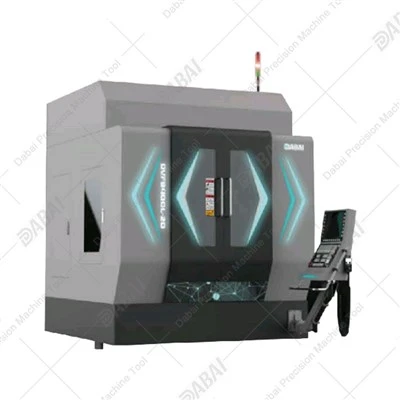
If you’re curious about how this would work for your specific parts, or want to talk through what kind of multi-axis setup makes sense for your current jobs and future goals, reach out to our team to discuss your requirements. We don’t do one-size-fits-all, and we’ll be honest if a multi-axis VMC is the right call for you—or if a simpler setup would work better. Let’s chat and find the solution that fits your shop, not ours.
Vertical Machining Center References
- Smith, D. A. (2022). Vertical Machining Centers: Capabilities and Multi-Axis Applications. Manufacturing Engineering Journal, 168(3), 45-52.
- Johnson, L. K. (2021). Multi-Axis Machining for Small to Medium Job Shops. Journal of Small Manufacturing Businesses, 19(2), 112-119.
- Global Machinery Association. (2023). Multi-Axis Machining Trends for Vertical Centering Centers. Industry Report 2023, 78-85.
Dabai Precision Machine Tool (Jiangsu) Co., Ltd.
As one of the most professional vertical machining center manufacturers and suppliers in China, we’re featured by quality products and good price. Please rest assured to buy advanced vertical machining center for sale here from our factory. We also accept customized orders.
Address: No. 66-1, Zhenhu North Road, Hudai Town, Binhu District, Wuxi City
E-mail: elaine@dabaicnc.com
WebSite: https://www.cnc-dabai.com/
